0.86 Quart West System 206-B Slow Hardener
This item can only be shipped UPS GROUND.
No Need for Excessive Clamping Force
Unlike traditional wood glues, WEST SYSTEM 105 Resin-based epoxy mixtures including 105 Resin and 206 Slow Hardener are stronger than wood or many other substrates. Because of this, it is beneficial to have some epoxy between the objects you are gluing together. As long as the parts are held in place and epoxy is contacting the entire surface of both substrates, no clamping pressure is needed. With epoxy, the goal clamping is to simply ensure the epoxy contacts the entire surface for the duration of the cure time. Moderating clamp force is all that is required.
If an epoxy filler is not used and a high clamping force is used, the result can be a glue-starved joint which will make bond failure much more likely. Glue starved joints are weaker than their counterparts. Avoid glue-starved joints by following the one or two-step bonding method.
Product Information
Product Information
Shipping & Returns
Shipping & Returns
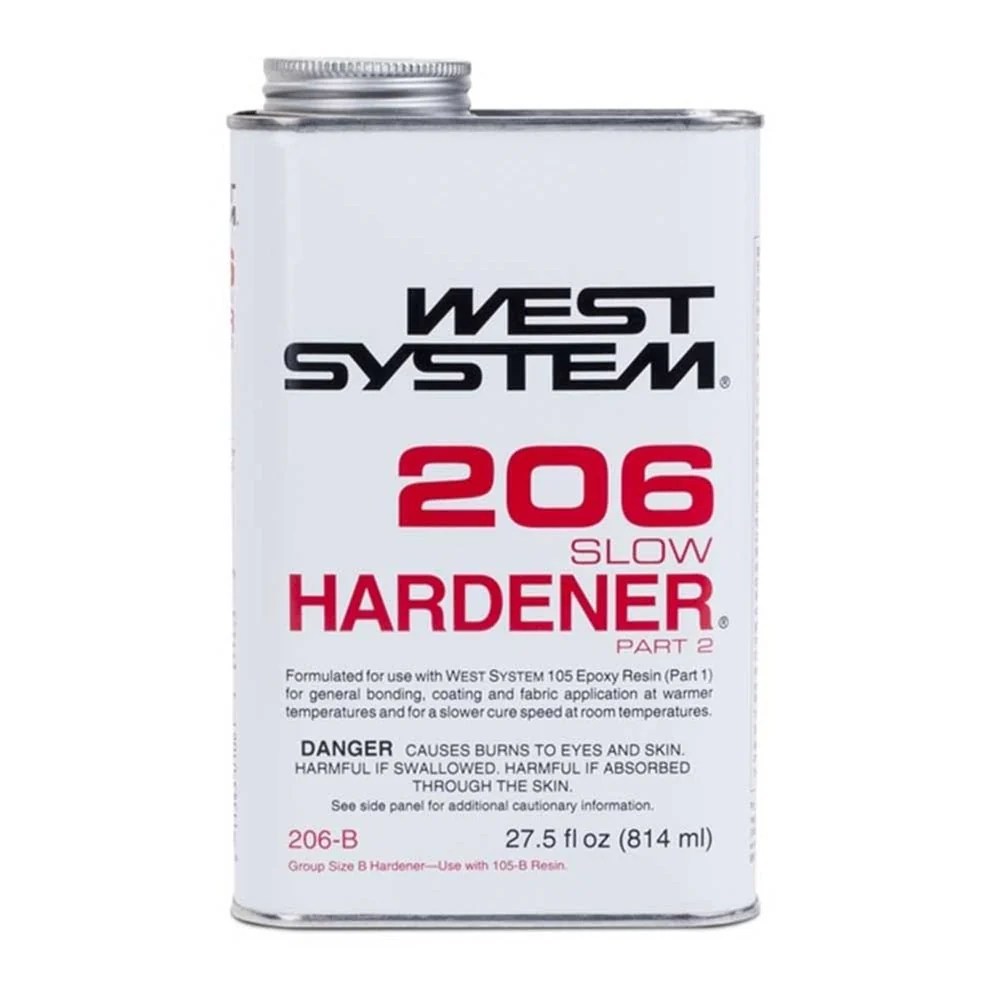
0.86 Quart West System 206-B Slow Hardener
0.86 Quart West System 206-B Slow Hardener
This item can only be shipped UPS GROUND.
No Need for Excessive Clamping Force
Unlike traditional wood glues, WEST SYSTEM 105 Resin-based epoxy mixtures including 105 Resin and 206 Slow Hardener are stronger than wood or many other substrates. Because of this, it is beneficial to have some epoxy between the objects you are gluing together. As long as the parts are held in place and epoxy is contacting the entire surface of both substrates, no clamping pressure is needed. With epoxy, the goal clamping is to simply ensure the epoxy contacts the entire surface for the duration of the cure time. Moderating clamp force is all that is required.
If an epoxy filler is not used and a high clamping force is used, the result can be a glue-starved joint which will make bond failure much more likely. Glue starved joints are weaker than their counterparts. Avoid glue-starved joints by following the one or two-step bonding method.
Product Information
Product Information
Shipping & Returns
Shipping & Returns
Description
This item can only be shipped UPS GROUND.
No Need for Excessive Clamping Force
Unlike traditional wood glues, WEST SYSTEM 105 Resin-based epoxy mixtures including 105 Resin and 206 Slow Hardener are stronger than wood or many other substrates. Because of this, it is beneficial to have some epoxy between the objects you are gluing together. As long as the parts are held in place and epoxy is contacting the entire surface of both substrates, no clamping pressure is needed. With epoxy, the goal clamping is to simply ensure the epoxy contacts the entire surface for the duration of the cure time. Moderating clamp force is all that is required.
If an epoxy filler is not used and a high clamping force is used, the result can be a glue-starved joint which will make bond failure much more likely. Glue starved joints are weaker than their counterparts. Avoid glue-starved joints by following the one or two-step bonding method.